The easy thing to believe in these turbulent times that we live in is that there is no common ground. It is us or them. It is my way or the highway. There will never be a tie that binds, and the ends of the rope shall never meet.
The British Navy adopted the custom of flying a starboard pennant defaced with a martini glass on the field as invitation for officers from nearby ships to board sociably for a drink. Nobody is quite sure when this gin pennant custom started. It was probably in the 1940’s and the tradition and practice continue to this day.
While this naval practice is virtually unheard of in the United States, it does exist here in a rather different form. Intrepid gin lovers will fly the gin pennant in front of their home as an invitation to random gin loving neighbors and in-the-know random folks alike to simply drop in and indulge. When the gin bottle has been emptied, the pennant comes down.
And that tradition is now moving beyond gin.
Jen Rubin is a Native New Yorker and is Jewish. As such, she knows her bagels. Jen really knows her bagels.
As a young woman, the path through life led Jen away the Big Apple and into the Midwest where she has remained for the past three decades. And while you can take the woman out of the Big Apple and the bagel culture, you cannot remove the bagel culture from the Big Apple expat. Jen has honed her Midwest bagel making skills and is also on the never-ending mission to find a New York-worthy bagel here in flyover country.
Jen has been documenting this search in the popular and entertaining Substack titled The Great Midwest Bagel Quest.
Jen had also dropped in on neighborhood gin-pennant gatherings and enjoyed how it brought folks together.
Then an idea struck.
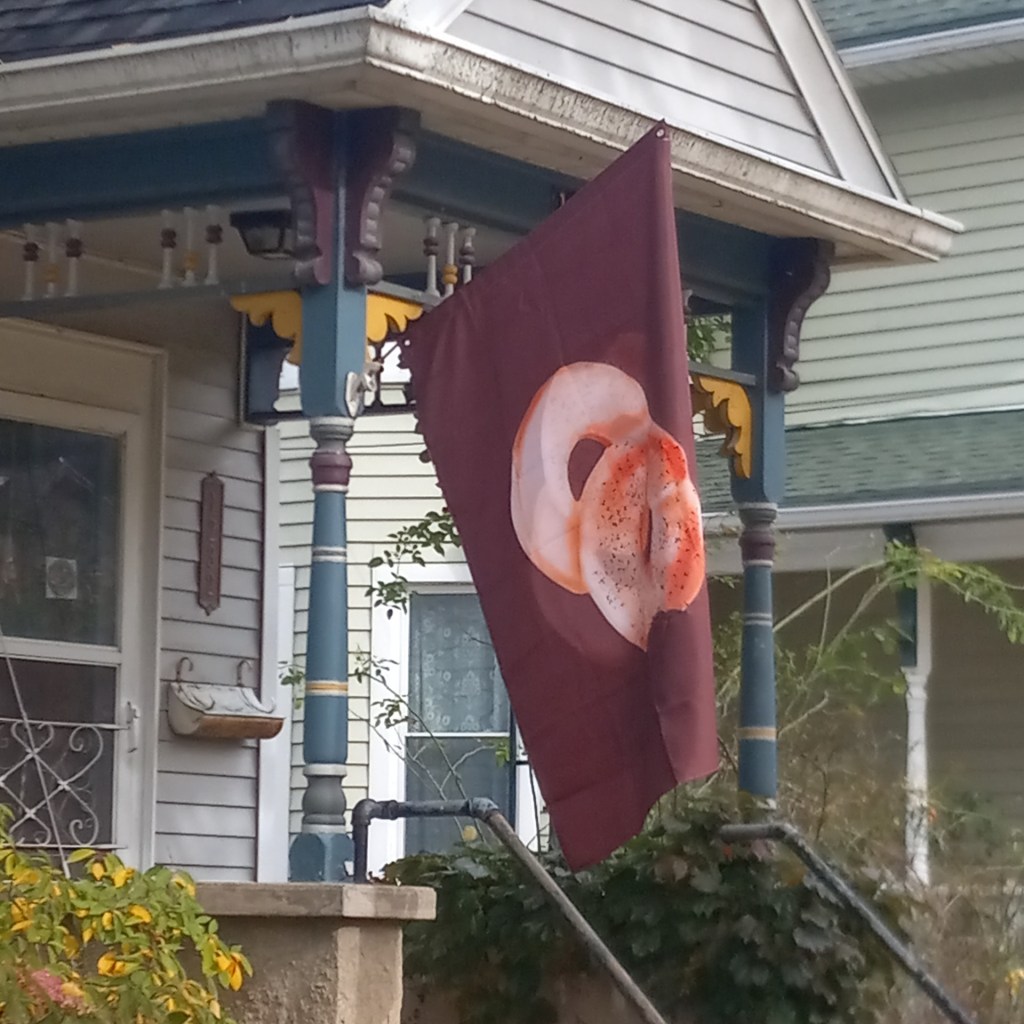
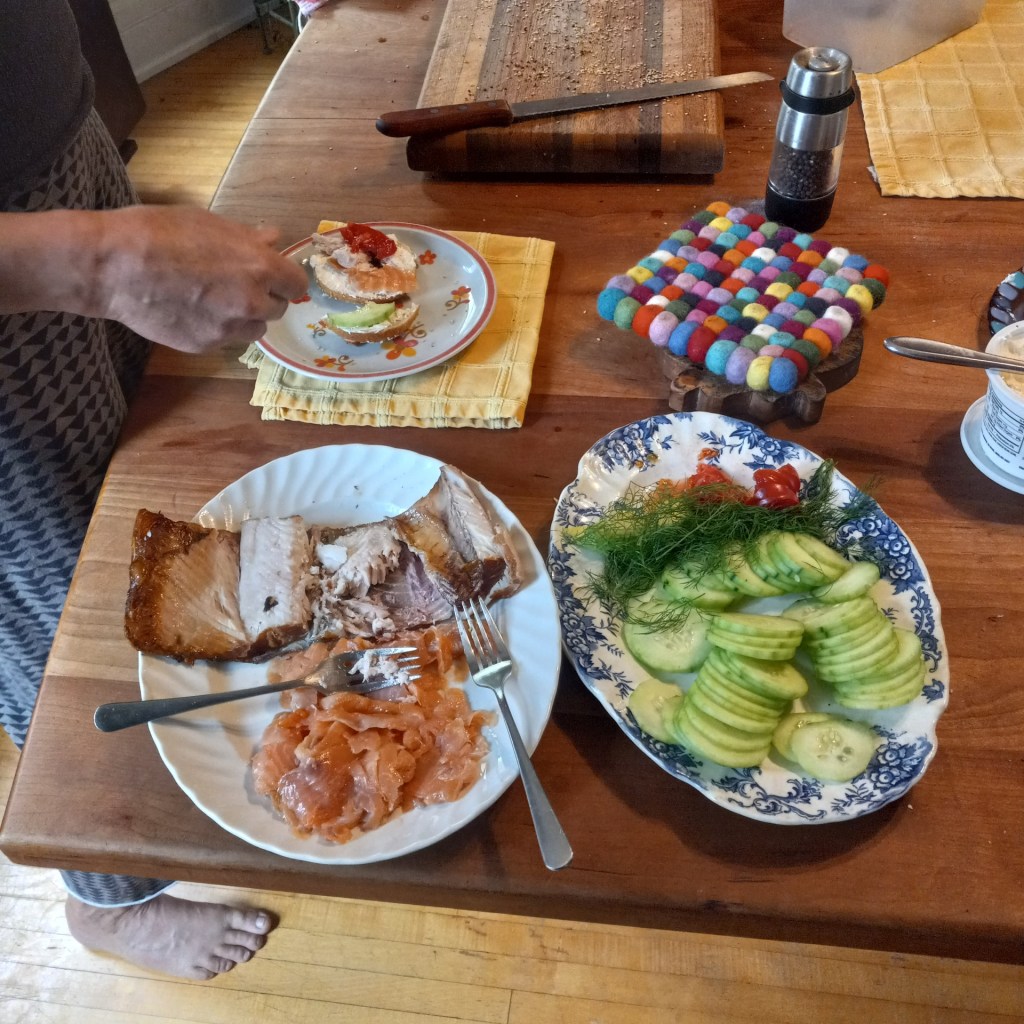
A buffet of bagels was prepared fresh, and the finest toppings were assembled. Coffee was brewed. Then at 10:00 am one Sunday morning Jen flew a bagel flag out on her front porch.
The results were astounding. While the focal point might have been delightful bagels most in the Midwest might otherwise never have the chance to experience, there was something much larger going on.
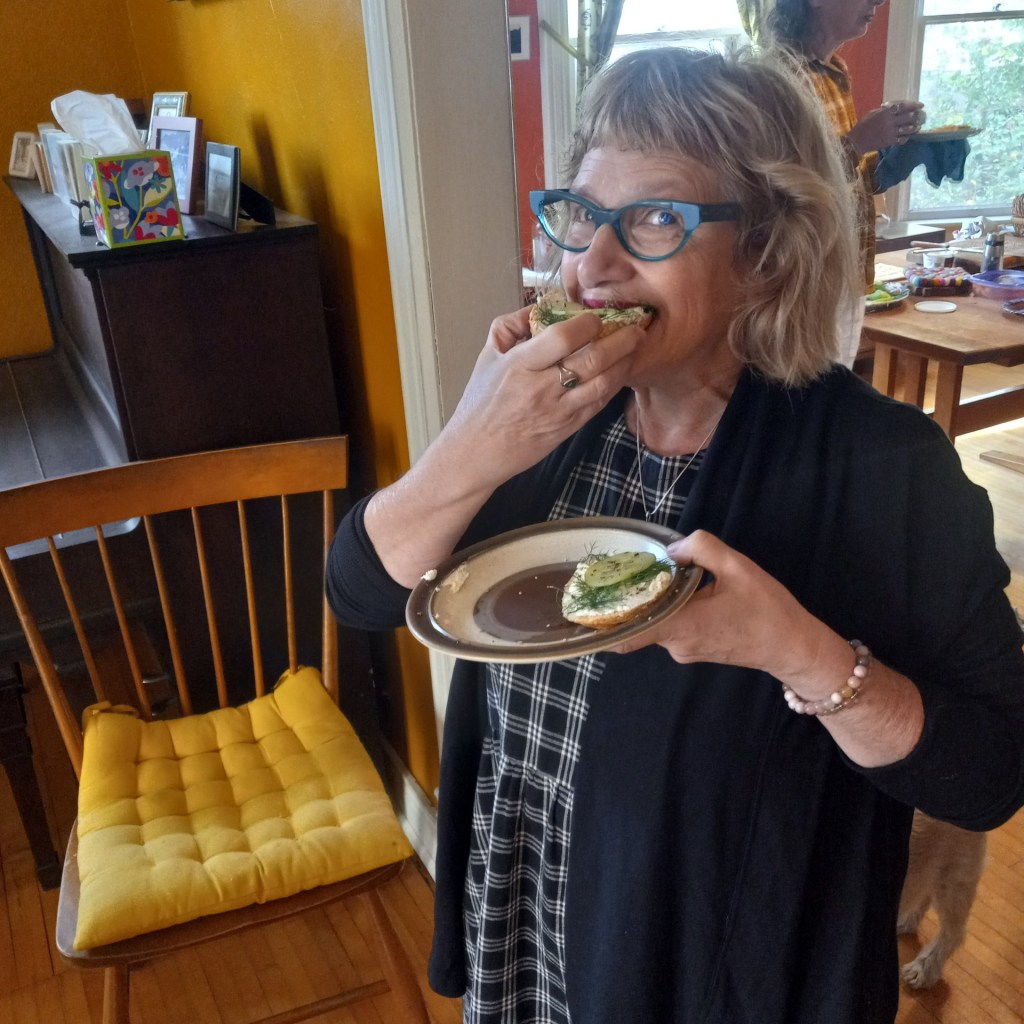
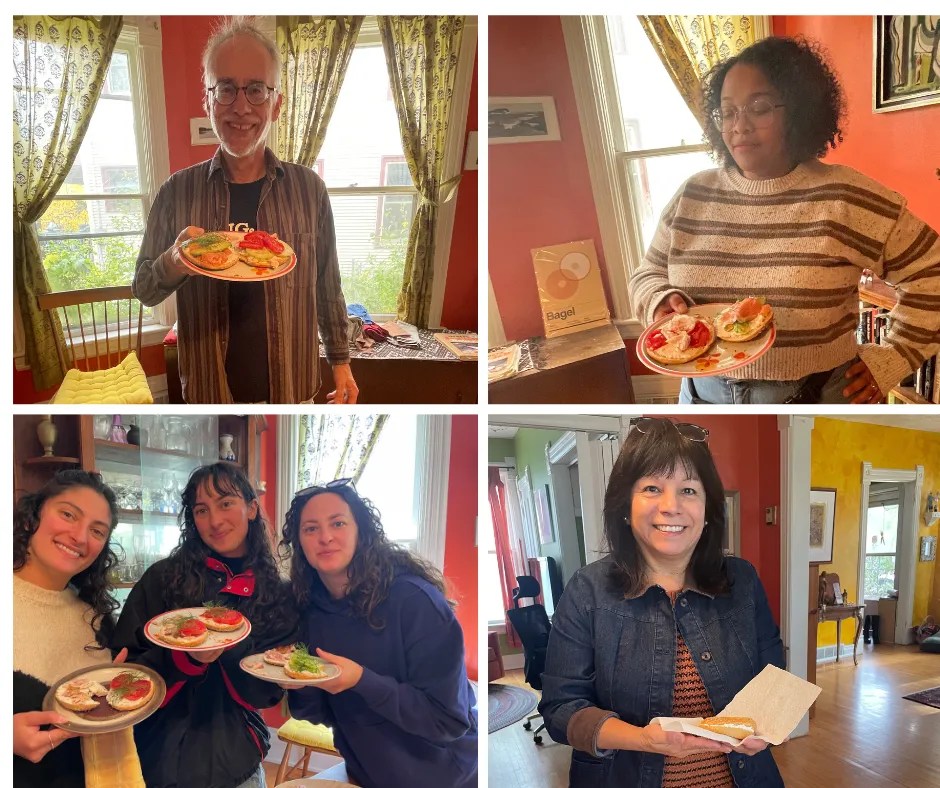
Attendees ranged from Jen’s dear friends, neighbors, to three women from the Netherlands here on an apprenticeship exchange, to a certain random Northwoods woodsman. Folks savored delicious homemade bagels topped with cream cheese, tomato, cucumber, avocado, and fresh whitefish from Port Wing, WI. There was pleasant get-to-know-you conversation over cups of coffee. There were fun bonding times and pleasant conversation while doing an exceedingly difficult jigsaw puzzle.
That morning produced smiles and pleasant company, warmth and connection. It produced folks being neighborly. As that morning concluded, one could scarcely imagine that we live in angry and polarized times.
The easy thing to do in these polarized times is to retreat and cower into our respective echo chambers, avoiding or simply not believing anything that might bring social, political, or intellectual discomfort or angst. The easy thing to do is to feel distrust and disdain for our neighbors who may not look like us, think like us, or talk like us. The easy thing to do is to think of them as them. Many of us are doing the easy thing.
Others are flying a bagel flag. Or perhaps a gin pennant.
Coming out in 2026 is Jen’s book expanding upon the Midwest Bagel Quest Substack. It promises to be a fun telling of a deeply historical culinary journey, with some very unexpected twists and turns. Yeah, you heard that right. Plot twists on a bagel quest!
Back in the day, my late friend Jamie used to tell a whopper of a fish story about catching trout with his bare hands. No tackle, no rod and reel, no creel; bare hands only.
The story and the location and techniques employed stayed consistent with each telling so it was plausible, and Jamie always told it so well that it never got old or stale. But it just seemed a little fishy. I just never could bite on the concept of him sneaking up then patiently easing a hand under the fish, slowly tickling its belly until lulled into an unwary state, then snatching the trout out of the water with a bare hand.
But truth be known, I don’t fish, so what do I really know?
But I do like to go on fishing excursions.
Landing a humpy at the Little Carp
One day friend Jeremy was planning to do some catch and release fly fishing on the Little Carp River in Michigan’s Porcupine Mountains and asked if I wanted to tag along. No need to ask that question twice.
It was a lovely day and there was a steady stream of happy hikers out enjoying the trails. Upon reaching the Little Carp, we left the trail and descended into the river valley.
I stayed behind Jeremy, so that the fish would not be spooked. He had on waders and very systematically began working the shorelines and waters while making his way downstream, occasionally pausing to pay extra attention and masterfully drop the fly very strategically into a pool or promising area.
Jeremy is a good fisherman. There was muscle memory and calculus and artistry behind each arced trajectory of the well-placed fly.
I, on the other hand, was perfectly content to bumble along comfortably behind in my knee-high rubber boots, wandering about in the cool water and scrambling up and down the banks. I climbed a small, but canyon-like sandstone cut wall and was startled by a snake upon breaking over the top but didn’t fall backwards. I then stared at a cloud for a while unable to decide whether it looked like Elvis or Tupac.
Jeremy slowed down to work a narrow part of the river with stair-step rapids, giving me the opportunity to pass him up on the bank high above.
The Little Carp widens and its bed levels out near its mouth, giving the tannin-stained waters a brief and lazy respite before colliding headlong into the rollers and surf of Lake Superior.
That water was about eight inches deep and there was a partially submerged log in the middle that made for a good place to sit while the water cooled my overheated feet. Occasionally there was a tap against my boots, but with the intense shimmer across the water I could not see the source. As the sun began to sink towards the horizon and the shimmer lessened. The river was thick with brown trout and salmon! Scores of fish!
And suddenly I felt the spirit of my late friend Jamie.
I did not need to sneak up on the brown trout as it was right there. And I did not lull it into a false sense of security by tickling its belly, as that just would have been weird.
But I did patiently slip my hand into the water, and when the moment was right, snatched the brown trout out of the water with my bare hand. I held it up before me and looked at it. In a rather weird moment our eyes locked and we had, like, a moment. I said out loud, “what the f(expletive)!”, and this next part may well have been my imagination, but it looked like the brown trout was mouthing “what the f(expletive)?” in return.
Jamie, wherever you are I am sorry for doubting you.
The entire fish out of water encounter lasted seconds at best. With a quick wiggle and a splash, the brown trout slipped out of hand and was gone.
“Jer, I caught a fish!”, I then shouted out incredulously, but he was too far upstream to hear. The half dozen folks standing about the river saw me standing in the water in black knee-high rubber boots, sans fishing pole and with empty hand outstretched. They probably uttered under their breath, “what the f(expletive)?”
Jeremy eventually made his way down. He listened patiently to this fantastic tale, then detailed his catching and releasing one humpback salmon and six king salmon. He obviously had a more productive day. But he cheated.
It is called many different things. Farmer blow. Loogie. Snot rocket.
Grandpa T had an old John Deere tractor, a “Johnnie Popper”. Those old machines were a marvel of simplicity with a slow firing two-cylinder engine rather than the more fashionable and higher revving four- or six-cylinders engines.
The old green tractor had an almost animate presence; it was nearly its own being. The engine rotated and fired so slowly that instead of vibrations it created pulses. Those lapses between power stroke pulses coupled with the torque multiplication passing through various gearsets to the rear wheels almost made the forward motion feel plodding, like a lumbering workhorse more so than a soulless amalgamation of cold cast iron.
My brothers and I spent a lot of time at Grandpa and Grandma T’s farm. They owned 120 acres but only about 15 were pasture, hay, and garden plot farmland. The rest was woodland.
Glorious woodland.
I have no photos of Grandpa on the old John Deere harvesting firewood, only this photo taken decades earlier with his team of horses near Camp 6 in Oma, WI.
Grandpa had spent a good portion of his working years in the lumber camps and spoke fondly about those experiences. The era of the lumber camps eventually ended just before the Second World War and the Iron County forester then lamented that there was no longer a marketable stick of wood left in the county. The old gyppo loggers joked that a woodpecker would have to pack a lunch when flying through.
But Grandpa T’s woodland was different. Bought as cutover when he was a younger man, he carefully manicured and culled and transformed what his contemporaries might have referred to as a “worthless stump farm” into a very stately and park like stand of mature sugar maple.
The surrounding parcels of land were also cutover. But in the absence of meticulous care, those adjacent parcels only became scrubby unmanaged second growth forests.
Grandpa’s Forest was majestic.
Our role as grandsons in Grandpa’s Forest was to help make firewood, which happened to also be his primary forest management tool.
His favorite harvests were smallish hard maple trees that had been standing dead long enough that they were beginning to shed their bark. They resembled weathered bones and were often small enough that they did not require splitting. He called them ram pikes and proclaimed, “No need to cut a live tree for firewood”. Another favorite to harvest were small young black cherry trees which would often die off quickly after their initial growth spurt. “Cherry burns hotter than sunshine”, he proclaimed. Cherry firewood was specifically reserved for the sauna woodpile.
The dead trees were felled and blocked into stove lengths then neatly stacked into piles in the woods.
In the winter he would carefully maneuver Grandma’s wide track Ski-Doo Nordic snowmobile through the woods with a homemade sleigh in tow, collecting the piles of cut firewood.
When there was no snow on the ground, he navigated through a very carefully planned series of trails with his two cylinder “Johnnie Popper” tractor towing a homemade trailer built out of the repurposed front end from a 1937 Ford. Grandpa would putt-putt through the forest, sitting bolt upright in the tractor seat and rhythmically and ever so slightly bouncing up and down seemingly in synch with the “pop-pop-pop” of the John Deere exhaust note.
The trails were very tight, and the forest was dense. Masterful and meticulously timed turns and deft application of the cutting brakes brought the tractor right alongside each of the precut piles of firewood scattered about. Seldom did Grandpa have to back up to make a second attempt at the notorious hairpin corners on his trails and never did he run over or skin or bump into a living tree alongside.
We would ride in the trailer as it bounced along behind the old John Deere. Upon reaching one of the many small piles scattered about, we would jump out and load the trailer.
Grandpa T apparently also had sinus problems.
He would be bouncing along and then would suddenly pinch a nostril then turn his head the opposite way. Upon suddenly giving a hearty blow, a large, um, phlegm ball that closely color matched the tractor would be launched into the atmosphere at what appeared to be supersonic speed.
Now most folks evacuating mucous from their nose sans tissue or a handkerchief might opt for having the gooey projectile fly harmlessly onto the ground. But Grandpa T was a man of many talents, and one well-honed talent that always impressed us boys was aim.
Grandpa T could always stick the slimy missile onto the rearmost apex of the rotating tractor tire. Centrifugal force would then transform the gelatinous splat into an extended mucous whip, sometimes a foot or more long. It projected out radially from the point of impact on the tire much the way centrifugal force radially extends a bullwhip out from the swinging hand of the user.
This biohazardous whip would swing forward and then disappear as the tire rotated forward, only be pummeled into the ground. On a bad sinus day this amazing spectacle might be repeated half a dozen times.
Grandpa T has long since left this world and I have never since seen another display of such talent.
We live in a noisy world. Horns honk, loud pipes save lives, and media blasts us.
Silence is a rare commodity these days.
Back in the day I was in the construction business. During the spring melt in the Northwoods there was a slack time between things drying up and the next building season. That down time was the perfect opportunity to head out to the backcountry of the American Southwest and slip into the landscape.
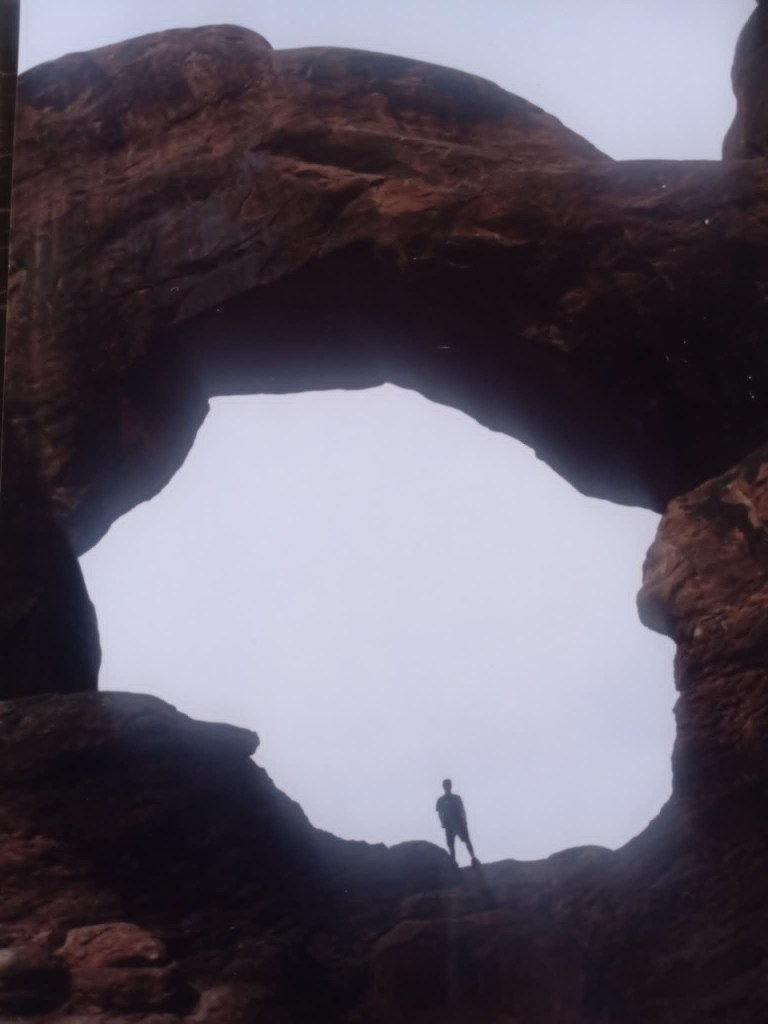
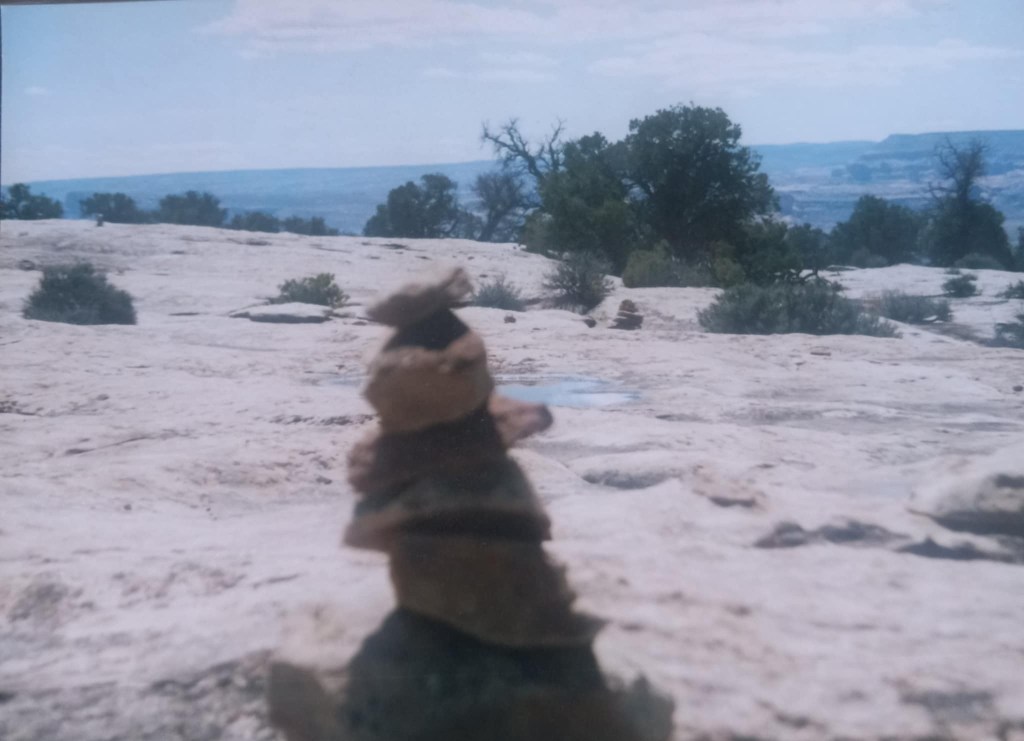
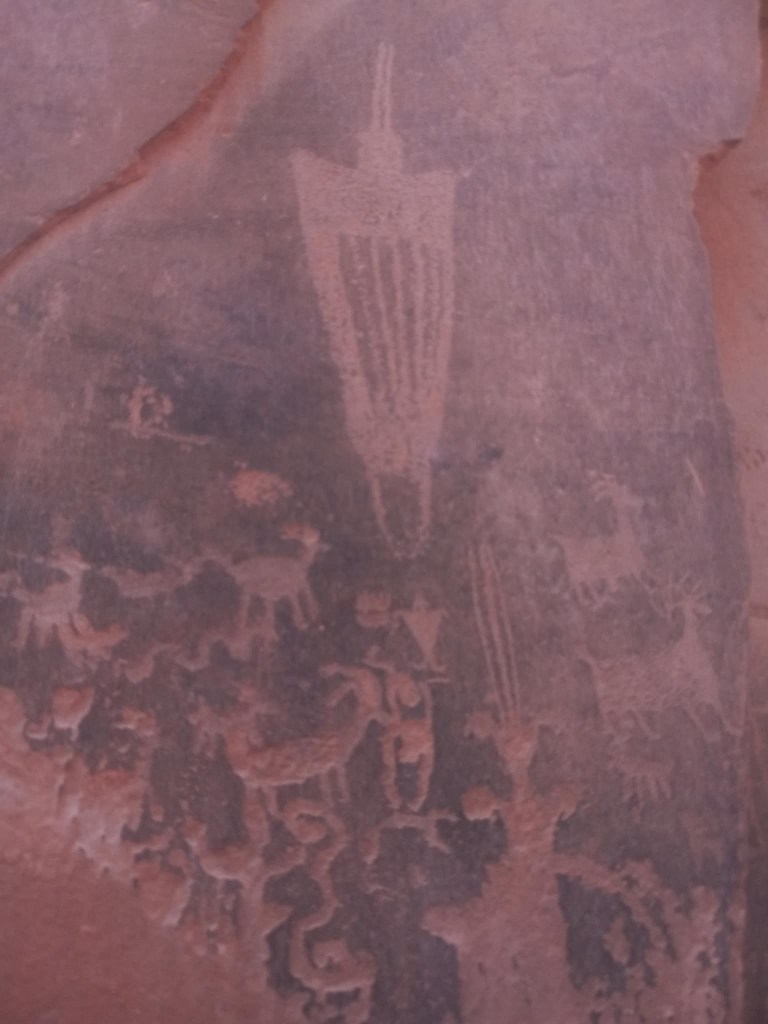
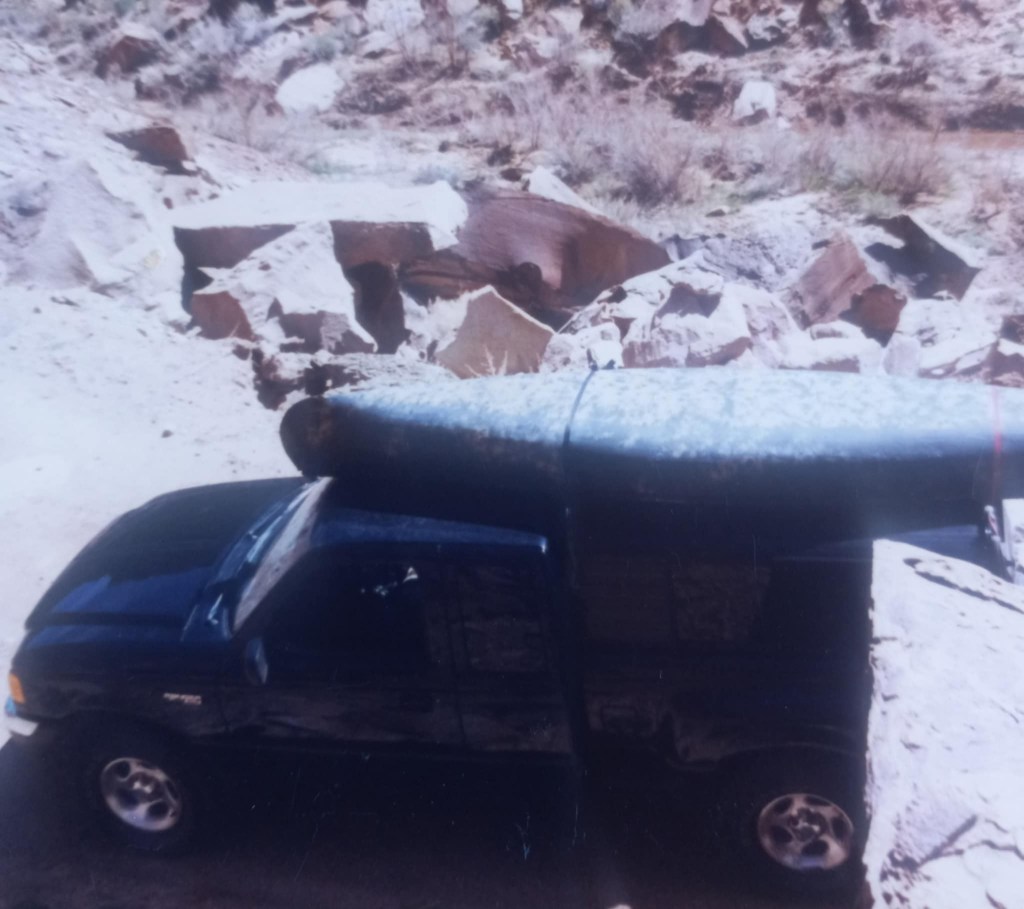
I took no photos during the adventure from this blog entry. All the photos used within are from other Utah adventures in the Moab and San Rafael Swell areas.
I owned a four-wheel drive pickup truck that had an insulated bed topper. With the addition of an air mattress, a sleeping bag, and a cooler big enough to hold two- or three-days’ worth of beer, bottled water, and sandwich makings; that work truck was transformed into a comfortable backcountry adventure touring machine.
Indeed, within the nine-year period owning that truck, in aggregate 3 ½ months were spent sleeping in that truck bed in the backcountry of Colorado, Utah, Arizona, and Southern California. But mostly Utah.
One noteworthy outing began with stocking the cooler in Moab, then venturing out into the San Rafael Swell.
On the first day out I turned off the truck radio and the cellphone, not that there was any cell coverage anyway. It was quite unusual not to see another soul out on the trails.
At a first glance from out on the open rangeland from many of the vantage points, the San Rafael Swell appears to be a rather vast bread and butter desert landscape.
It simply is vast.
And it is truly humbling to look towards the horizon then turn and do a full 360-degree view and soak in that incredible expanse. Even the most nonreligious person will surely feel like a tiny child safely cradled in the palm of God’s hand when out on the rangeland of the San Rafael Swell.
But then carved out of that open rangeland are labyrinths of canyons and buttes and washes. Within those are beautiful and captivating landforms as well as pictographs and glyph panels depicting the secrets of the ancients who once lived and traversed the Swell. In modern terms, other than some random cattle, an occasional decrepit pump jack, or an old and abandoned glory hole wildcat uranium prospect, there is little evidence of the hand of present-day humankind.
Which suits me just fine.
I remained silent, kept the truck radio and the cellphone silent, encountered no other human beings, and kept on wandering and exploring and soaking in the overwhelming majesty.
Truth be told, I am a sweaty man and by late morning of the third day out it was time to wash up, not that there were any other human beings present in my little cloistered universe to offend. The provisions were also exhausted, but I remained hydrated by drinking the rather horrible tasting melted ice water out of the cooler.
The monk-like silence would soon have to end with a trip into Moab to restock.
There was erosion on the shore of the Green River that washed out the brutal tamarisk brush and offered a gap with access to the water. I stripped down then made my way down the bank. The first steps into the water were stingingly cold and felt like electrical shocks, and each tiny splash to wet my body was breathtaking.
About the time I was lathered up, faint human voices could be heard in the distance. Moments later two kayakers came around the bend flanking the far bank.
And there I was, bare ass naked, soapy, and knee deep in the frigid spring melt water of the Green River.
Perhaps it was a sense of modesty or perhaps it was being self-conscious of an extraordinary amount of shrinkage that made me wade out a little deeper and slip into the water until only my head was above. The water was painfully cold, and my heart pounded like a sledgehammer.
It should have been impossible for me to go unnoticed but perhaps the kayakers felt as awkward as I did. Perhaps they pretended not to notice. Or perhaps, they wanted to afford me a last shred of dignity. They passed and I retreated shivering violently and with blue lips. Upon drying off and first crawling into sleeping bag for about a half of hour then laying out in the warm sun, the shivering subsided.
I was at first bitter that it had been others who ended the two-and-a-half-day period devoid of human voices and not me. But they too were on their own quest. No doubt rounding a bend and discovering a naked soapy scrubbing off the stink man in the river probably harshed the buzz of their experience as well.
All is fair and all is forgiven in embarrassing situations.
And now, over twenty years later, the significance of that adventure and experience and that wonderful silence still resonates within me. And these days it no longer takes a trip to an exotic land and a vow of silence and drinking cooler water that tastes like spoiled lunch meat for me to silence the mayhem of the world.
A television set that is seldom turned on was a good first start. A walk through the woods with Stormie the Trail Dog and a loved one instills serenity. An unexpected and easy conversation with a random stranger discussing a common interest can silence a lot of the incessant vitriol and shouting that is all about us. And while it is becoming increasingly difficult to find truly wild places anymore, getting intentionally lost in such wild places can insert some life changing peace and quiet into the very fiber of one’s being.
These are some very uncertain times we are living in. Things are happening hard, and things are happening fast.
By now most who read this blog are probably aware that National Endowment of the Humanities grant funding has been cancelled. This also means the end for Wisconsin Humanities, unless Congress reverses this order.
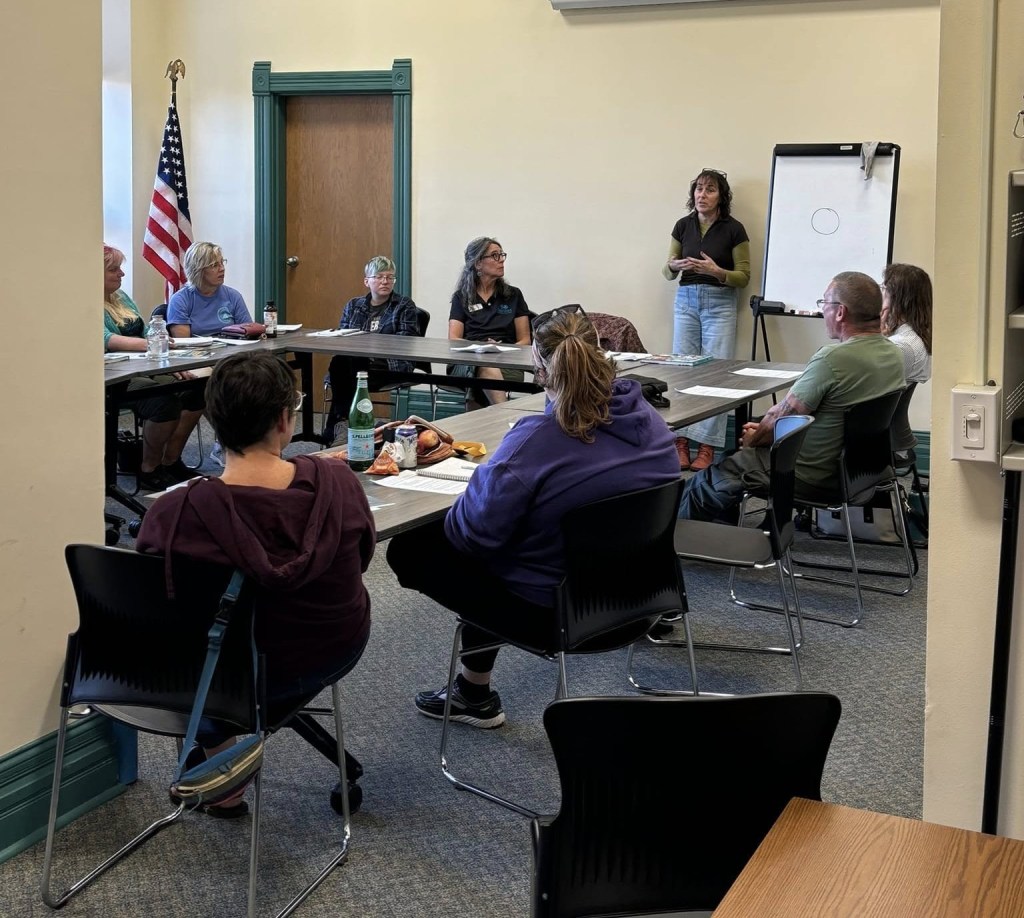
A Love Wisconsin workshop held in Ashland, WI
For 50 years Wisconsin Humanities has told the stories and history of Wisconsin. These are the stories of our friends and our neighbors. The places are here, in our state, along our country roads and within our neighborhoods. Wisconsin Humanities has featured every corner of the state, and the Northwoods have been very well represented.
Personally, I am a big fan of Wisconsin Humanities and Love Wisconsin. I am avid follower. I love to read the stories. I enjoyed participating in a Love Wisconsin workshop held here in the Northwoods. My own quirky story was profiled by Love Wisconsin.
We cannot let Wisconsin Humanities and Love Wisconsin slip away. Please take a moment to read the words of Jan Mireles Larson and Scott Schultz below. Then please take a moment to contact your federal legislator, or to do whatever you can to help.
This is the story of us, all of us here in Wisconsin, and it is about to be erased. Please, help.
Gerry Nasi
Montreal, WI
Lost-In-The-Forest.com
Humanities needed for Wisconsin communities’ strength, growth
By Jan Mireles Larson and
Scott Schultz
Dennis Miller worked at Eau Claire’s Uniroyal plant for 15 of its 75 years. A major employer in the river town, the plant closed in June 1992 jettisoning more than 1,000 workers and shaking one of the town’s economic bedrocks.
When two local film makers approached Miller asking to share his story, he said yes. The film is an example of a project backed by Wisconsin Humanities; the film makers and Millers know the importance of such a program.
“The humanities are a necessity for people to know the truth,” Miller said.
For more than 50 years, Wisconsin Humanities has partnered with Wisconsin people to remember our shared history, our culture and, to build the bridges that help us understand who we are, where we’ve been and where we might go – together.
All is at the precipice following DOGE’s assault last week on the National Endowment for the Humanities. In the middle of the night, WH Executive Director Dena Wortzel got word that all federal funding had evaporated, effective immediately. Federal funding accounts for 85 percent of Wisconsin Humanities’ annual budget of roughly $1.2million. The rest comes from the state and private donations.
Even though Congress allocated current-year funds in mid-March, the termination letter that WH received from the acting chair of the NEH states that its grant is eliminated in its entirety. That grant award includes $400,000 for FY24 that will no longer reach Wisconsin communities unless Congress acts to reverse the order. The non-profit’s eight-person staff serves every Congressional District in the state through grants and programming partnerships with communities, libraries, historical societies, museums and other non-profits, is only months away from closing its doors.
BJ Hollars is one of the filmmakers behind, “When Rubber Hit the Road,” a documentary about the closing of Eau Claire’s Uniroyal tire plant and its aftermath.
He understands just what will be lost if Wisconsin Humanities is shuttered.
“Upon receiving a grant from Wisconsin Humanities, my film partner and I were able to create a one-hour documentary that captured one of our region’s most vital stories – resilience in a time of manufacturing decline.”
Beyond telling a story, Hollars added, the film “served as an economic driver, more than doubling the grant money we received from Wisconsin Humanities and placing it directly back into the region’s theater’s hotels, and restaurants.
What will the end of Wisconsin Humanities mean?
Grants: Wisconsin Humanities’ grant program provides support for public humanities projects that strengthen our democracy through educational and cultural programs that build connections and understanding among Wisconsin citizens. Last year, 220 grant-related events were funded, with more than 80,000 participants.
One recent grant went to the Headwaters Council for the Performing Arts in Eagle River, Wisconsin. The council sought funding for a single performance based on the songs from WWII. Planning for one concert mushroomed into collaborations with multiple community organizations. They reached out to area vets for a “Veterans and Families Expression Day,” that sought to move beyond the “thank you for your service” statement and into a tangible response to assure area vets and families their memories and experiences have value. Library exhibits, veteran’s writings and art pieces were woven into a series of events. Collaborators included the library, the arts center, and local Veterans Service Office.
Norma Yaeger, HCPA board president, said the WH mission was as essential as the grant funds.
“They (WH) provided the framework to see ourselves as elements of our local social fabric,” she said, “We challenged everyone to be a listener, to engage those who have a story to tell before it’s too late.”
Wisconsin Humanities also helped veterans’ voices be heard during a recent storytelling clinic at The Highground Veterans Memorial Park near Neillsville. Earlier, WH worked with The Highground to create a “My War: Wartime Photographs by Vietnam Veterans.”
Community Powered Project: Launched as a pilot in 2021, the project builds resilience in Wisconsin communities by helping them identify community needs and launch projects to meet those needs.
For example, in Spooner, Wisconsin, Angela Bodzislaw, a local librarian relied on Community Powered to launch Teen Powered, a program that connects teens and local community leaders to identify local needs and support teens in meeting those needs. Projects have included a community clean-up initiative, a park repair, and a collaboration between teens and community leaders to repurpose a building for a youth center.
Bodzislaw, who says the program is in its third year and self-sustaining, credits WH with supplying the infrastructure and training needed to get Teen Powered up and running.
“We wouldn’t have come up with it on our own,” she said, “because we wouldn’t have had the time (or skills) to do it.”
Love Wisconsin: A digital story-telling program that for the last 10 years has produced more than 150 voices connecting neighbors and communities with first-person stories.
Human Powered: A podcast series about how people make places better, Human Powered shows what happens when passionate, creative people engage deeply with neighbors and find ways to strengthen the roots of community lives. More than 3,500 people listened to the podcasts in 2024 with an additional 6,300 people visiting the website.
Program Partnerships: In addition to its own programs, Wisconsin Humanities provides financial support for humanities programming across the state. WH partners with Wisconsin Public Radio and its “Wisconsin Life,” radio programming, airing radio essays that celebrate what makes Wisconsin unique through the radio stories of its people with approximately 70,000 listeners each week.
WH also supports the Wisconsin Poet Laureate Commission and the Wisconsin Poet Laureate, the state’s ambassador for poetry.
Wisconsin historian and author Jerry Apps, who’s worked with Wisconsin Humanities on a variety of projects, offered a simplified explanation of what the humanities mean to us.
“My dad used to say, ‘there’s a tremendous difference between having information and knowing something,’” Apps said. “Humanities get to the ‘know.’ ‘Knowing’ gets to the depths of who we are.”
If the humanities teach us anything, it is the power of what we can do together. Action is needed now to safeguard one of the foundations of Wisconsin’s community.
What can you do?
Call your federal legislators. Congress.gov allows you to type in your zip code to find your representative’s contact information. Ask them to support NEH and Wisconsin Humanities.
Go online to WisconsinHumanities.org and see for yourself just what WH does. Then, donate to show you want to build community with friends and neighbors across the state.
Share your own Wisconsin Humanities experience and advocate with friends, families and neighbors.
For his part, Miller is grateful to have told his story through “When Rubber Hits the Road.”
“The humanities are a form of expression of love,” he said. “And love doesn’t divide, it multiplies.”
Jan Mireles Larson of Eau Claire is a Wisconsin Humanities Board member.
Scott Schultz, a Wisconsin Humanities Board member, is a Marine Corps veteran, retired print and broadcast journalist, and founder of a nonprofit writing and arts program. He lives on a small northern Driftless Area farm near Osseo.
On a cold winter day, not only was I at the rally, not only was I at the march, but I was inside of the Capitol.
It is hard to describe the cacophony of the amplified voices and the buzzing crowd and shouts and cheers and jeers and applause reverberating within the labyrinth of marble corridors. There was sheer electricity in the air, and one could barely hear or understand a person an elbow length away let alone the speaker front and center, such is the ear-splitting noise.
And the march, oh, the march! A thousand took to motion as if one.
One felt less like an insignificant one and so much more like an empowered and integral part of a much greater whole during that march! A look over the shoulder revealed a seemingly endless stream of humanity taking up the rear, while out front was an equally endless stream leading the charge. Messengers with bullhorns roused the marchers into a frenzy and whipped the marchers into angry retort. The messengers had the power to have the marchers shake their heads in disbelief or hang their heads in sorrow.
The rally itself was rousing and emotional and infuriating and hopeful. The protesters hung on every word and rode upon waves of enthusiasm laced with anger. When a gasp surged through the crowd, it was the gasp of a thousand. When anger swelled it was the swollen anger of a thousand. When hearts were broken it was the shattered hearts of a thousand. And that joining of a thousand became an all-powerful one.
The message was simple. Ignoring hard facts, inserting falsehood, and killing advancement would drive our Country and her people backwards. The solution offered was to fight, to fight like hell and keep things moving forward.
There were a few things that certainly did not happen on this day of Peace and Love.
Members of law enforcement and the capitol police were not attacked, injured or harassed. Public property was not violated, breached, damaged, nor defecated upon. Legislators did not flee for their lives, and nobody was injured. And nowhere to be seen was a face painted and shirtless chucklehead parading about with buffalo horns atop of his head.
On March 7, 2025, that day of Peace and Love, supporters of science and scientific research gathered at our state Capitol in Madison, Wisconsin, for the Stand Up for Science Rally.
There were many speakers that day including a survivor who told of her heroic tale of battling thyroid cancer and a farmer who stated farmers “do their best until something better comes along”. The common threads winding through each of the speeches were the impacts that science and research had in saving lives, reducing human suffering, responsibly feeding an increasingly hungry planet, as well as simply making the world a better and safer place to live.
And much of that that science and research is now in grave danger of funding cuts simply because of certain benign key words in the grant titles such as “female” or “diversity”, with agricultural research grant titles being a prime example.
For 6000 years humans have known that monoculture agriculture is a path to failure and starvation. And the opposite of crop-monoculture is crop-diversity, which equates to success and plenty. Yet there is a war on the word “diversity” being waged by a Special K stuffed narcissist billionaire that is being carried out by his hapless lackeys apparently searching for keywords rather than doing the hard work of doing the hard work. This inept buffoonery leads to the headlines about transgenic mice that leads to the rest of the world laughing at our sheer absurdity and stupidity.
And it can lead to good science being tossed into a trash bin.
It is not rocket science to understand that today’s research and science-based initiatives become tomorrow’s medical or technological breakthroughs. It is not rocket science to understand that killing off these science-based initiatives allows others the competitive advantage that we have long strived toward and held. Fun fact-rocket science has been brought to us through research and science-based initiatives.
And as everything these days happens to be, this March 7, 2025, Day of Peace and Love was very political in nature. But there were no vitriolic election lies or conspiracy theories. There was no fearmongering or hate speech. There was no scapegoating nor the creation of any boogeyman, real or imagined. And when the speakers talked about elections, they did not instruct anyone to vote for any specific candidate nor was there pathetic whining about hair brained conspiracy theories or the peddling of unsubstantiated lies.
The speakers simply asked that everyone in attendance get out and vote.
Which brings up a very good point. There is an election on April 1st in Wisconsin.
I watched with horror as the Los Angeles riots streamed live on TV. How could this possibly happen in the United States of America?
A few years later, we were at a festival in Reno, Nevada, having a grand time. The entire city was abuzz with both sanctioned events as well as many venues providing entertainment aimed at getting the swell of visitors through their unsanctioned doors.
There was excitement in the air. We did not sleep for two days, reveling in the good fun and the never-ending party and the outstanding music that seemed to emanate from everywhere. Upon approaching the threshold of sensory overload, the excitement was ratcheted down a bit with a Beach Boys concert held in an outdoor amphitheater, which was pure mellow gold.
Driving back to the hotel after that concert, the streets suddenly seemed ominously vacant. Upon easing up to a stoplight at an intersection with no traffic to be seen in any direction, a crowd gathered around what looked like a little hole-in-the-wall business or bodega. A man appeared to be standing his ground before the front door. Something was certainly going down.
Courtesy of Reno Gazette Journal
The mob then spilled out into the street. With a quick stab of the accelerator pedal, the rental car blew through that stoplight and then a few more stoplights as well. Approaching Downtown, we were suddenly a piece of rental car flotsam trapped in the deadpool of a honking, fist-waving traffic jam that ground to a halt a half of a block from our hotel.
The sound of sirens pierced the night and there was a burning stinging stench in the air.
“I’m sorry, the hotel is on lockdown”, the security guard at the curb forcefully exclaimed when we were finally able to jockey out of the grips of the jam and onto the hotel driveway. “Nobody in, nobody out!”
“This is a rental car without the rental car insurance”, I rudely shot back, wildly waving our room key. “Let us in, or I will smash through that motherfucking sawhorse!”
Tensions were running high.
“You are a guest,” he acquiesced and then looked over his shoulder warily, no doubt hoping the manager’s attention was focused elsewhere before nervously moving the barricade aside.
A sudden wave of calm came with securing the econobox in the hotel parking lot. After a deep breath we went over to that same security guard to find out what was going on. “There’s a riot”, he replied very casually and pleasantly. He seemed to bear no grudge over me snapping at him just moments before.
Apparently, all is fair, and all is forgiven in riots.
We watched a near carnival atmosphere erupt within the traffic jam that moments before entrapped us. After witnessing an impromptu amateur strip tease act performed on the decklid of a gridlocked convertible so graphic that even the most hardened ecdysiast might blush, we had enough. The riot raged on in the distance.
We reached the safety of the hotel room and with the riot out of sight but not out of mind came a wave of second thought. One doesn’t often see a riot in Northern Wisconsin. And this being in Nevada the most Cousin Eddy thing one could do would be to grab a cold six pack of beer and head back into the streets, and I did just that.
There was a crush of bystanders surging away from the violence and the assembled line of riot police, but I pressed on against that wave. Skirmishes erupted between the rioters and other rioters, and the rioters and the line of officers that swept down the street. And then almost as quickly as it erupted, the riot was suddenly over.
Years later I learned from some witnesses and participants in other riots, such as the L.A. Riots, that Reno 1998 was not a very big deal as far as riots go. But it was a pretty big deal for me.
Courtesy of Reno Gazette Journal
As a nation, we are currently sitting on a powder keg and those who we entrust to be minding the fire extinguishers are the very people boisterously strutting about carrying cans of gasoline and boxes of matches.
And there is an old saying amongst carpenters and weaponry analysts that if the only tool in one’s toolbox is a hammer, everything one sees will look like a nail.
So, along with the gas cans and matches, these cowardly bullies have also gained control of the hammers and would love nothing more than for protests to be waged against their agendas. The slightest hint of violence whether real or imagined will only grant license to use the full force of our government and military against American people.
Let us speak our minds without fear but also speak peacefully and with kindness. Let us not offer any fuel to petulant children playing with matches.
And let us not be too quick to judge our neighbors. There are many who once thought themselves to be nails who have recently perceived that they attained hammer status. It will be found out soon enough by all that the only hammers being passed out will go to a very select few and their lackeys, and the rest of us will all be the nails whether we ushered in the hammer or not.
For those who have never been in a riot, a good listen to get the feel is the LA Riots inspired Sublime song “April 29, 1992”. That song begins slowly and subdued then morphs into ominous guitar riffs before erupting into an angry crescendo, only to suddenly dissipate back into the riffs before abruptly fading. Exactly the feel and the tempo of the energy and violence of a riot.
For those who have never actually seen a riot, there is a trove of images and footage that can be viewed from a recent major riot, a shameful event that dwarfed the 1998 Reno Riot. This particular riot began with an unruly mob assaulting police officers and others from law enforcement, then forcing their way into a place they did not belong, trashing a building and destroying and vandalizing property, then threatening to hang the vice president of the United States. Exactly the feel and the tempo of the energy and violence of a riot.
Stay tuned for the continuation of this in the next blog post.
The Northwoods abounds with natural beauty. We stand in awe of the natural treasures stretching from the splendor and majesty of Lake Superior and the remaining virgin timber in the North to the endless sandy beach shorelines of the constellation of lakes in the Northern Highlands to the south.
But within all of this natural beauty exists some man-made treasures as well.
The Black River Harbor and Park is a paradoxical place. Black River Road tumbles its way downslope, accessing exotic waterfalls while winding through magnificent old growth forests. But then the park entry is very mundane and a universal design common to most parks. The grounds lying beyond are very neat and extremely well kept but look like almost other every neat and well-kept park everywhere.
But strolling beyond and below the crest of the manicured grounds allows entry into another world. For there lies a picturesque marina with pleasure and fishing boats moored to a tree lined walkway and dock flanking the near bank of the Black River.
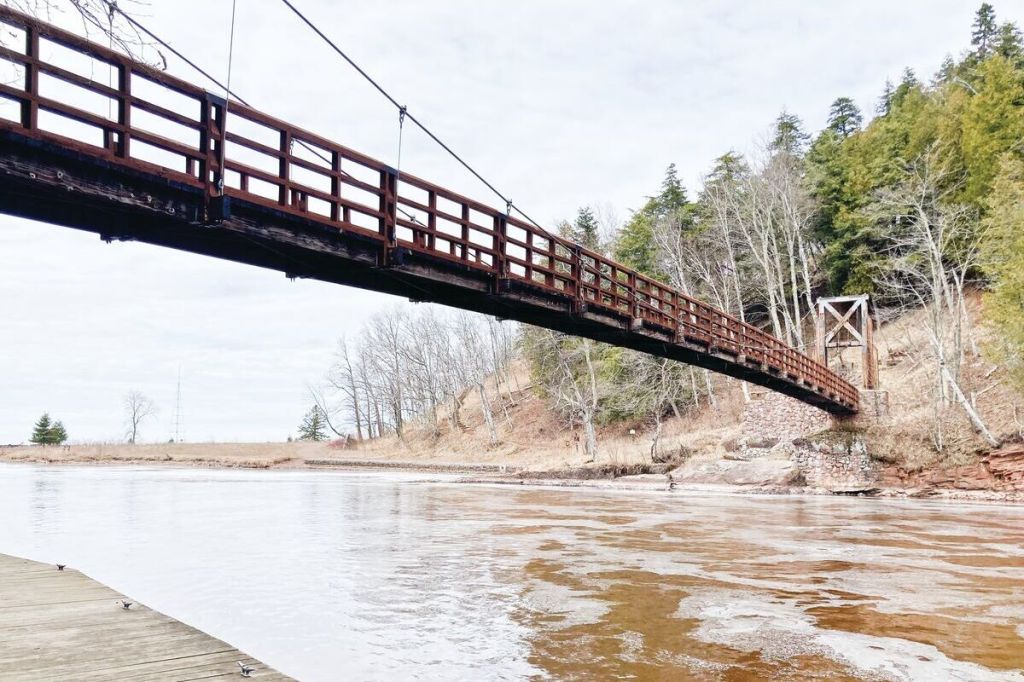
Spanning the Black River upstream is a rustic foot bridge constructed from timber harvested and milled onsite. The graceful suspension design lends the roughhewn structure an air of simple elegance.
Black River Harbor suspension bridge, courtesy of The Daily Globe
While the near end of the bridge is anchored onto the manicured grounds, the far end collides with the toe of a rugged bluff cloaked with towering ancient white cedar and pine and hemlock trees. A rustic trail is obligingly nestled between that bluff and the opposite shore of the Black and sweeps onto a wide and inviting sandy Lake Superior beach that stretches far off into the distance.
For generations, star-struck young couples met on those neat grounds, coyly strolled across that gently swaying bridge, and while on that magical beach beyond and with a million stars in the dark sky above as witnesses and with the waves lapping rhythmically at the shoreline, fell in love.
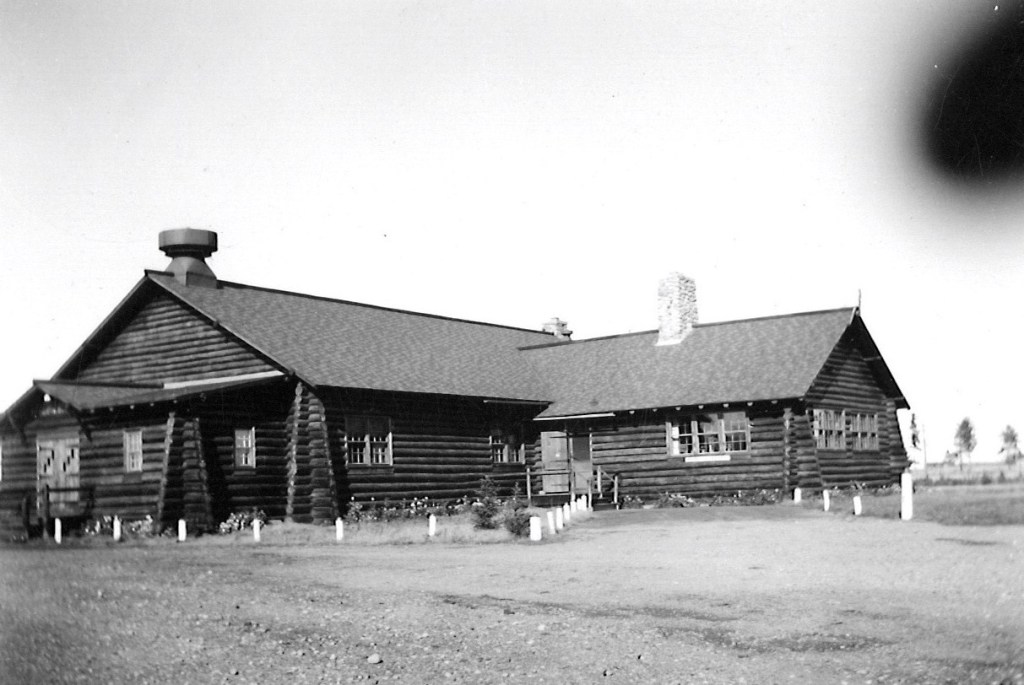
Constructed in 1936, the original Mercer Public Library and Community Center was built from locally felled virgin pine. Finnish woodsmen saddle coped and fitted the massive logs, resulting in not only an aesthetically pleasing building that oozed Northwoods appeal, but one that was also a tightly fitted and cozy sanctuary suitable for braving the extreme winters. But by the 1950’s the log building fell into disrepair and eventually ignominiously served as a mere storage building.
Original Mercer Community Center and Library, courtesy of the Library of Congress
In the 1990’s, the old log structure was disassembled and lovingly repurposed and integrated into an expansion of the new Library and Community Center. This gave new life to the old structure and passed along the beauty and old soul of logs hewn by nameless and faceless woodsmen that history has long since forgotten.
The 105-acre Norrie Park is indeed a very sprawling park for Ironwood, MI, a city of only 4,957 residents.
Norrie Park began its life as the 3601st Company CCC Camp. Ultimately, that installation was decommissioned as the United States transitioned from the mass unemployment of the Great Depression to massive labor shortages in the runup to the Second World War. The actual camp barracks and many of the old structures had been removed as the grounds transitioned from camp to park, and park-related amenities were constructed. But those picturesque grounds remain and here and there are the remnants and ruins of carefully laid stone masonry structures that give clue to the past.
Norrie Park, courtesy of City of Ironwood
A constant is that generation after generation has loved Norrie Park, has grown up in it, and has grown old in it. It is a Western U.P. tradition for family gatherings, graduation parties, class reunions, wedding receptions; Norrie Park is a very happy and beautiful place that beckons pleasant congregation.
The Ironwood Township Resettlement was a grand social and economic experiment, a magnet garden community for struggling families. Sturdily built and sensibly attractive, the Resettlement’s brick homes were constructed in a row house type arrangement with very generous back yards for planting vegetable gardens and raising poultry and small livestock.
The Ironwood Township Resettlement, courtesy of the Library of Congress
The Resettlement achieved its initial objective of preventing the Gogebic/Penokee Iron Range from depopulating during hard times. It has lived on long past that initial vision and purpose and has provided subsequent generations with durable and affordable housing stock.
The common thread winding through these local treasures is that each were WPA, the Work Progress Administration; or CCC, the Civilian Conservation Corp administered, and were government funded projects.
But what if these projects never happened?
The trout and salmon, the otters, and the ancient white cedar and hemlock of the Black River area would be doing just fine had humans never gained easy access. But generation upon generation of humans have stood in awe of the falls, the beauty of the Black River and Harbor, and the majesty of Lake Superior. If that park never was, what if it was your grandparents or parents that never met on those grounds or crossed the gently swaying bridge? If that park was never created, might you not even be?
Books can be stored efficiently in a warehouse. But what if the gravitational pull of an unknown ancestor hewing white pine logs with a broad ax and a draw knife was just enough to attract a present-day youngster away from antisocial media and into the woodsy and old soul sanctuary of today’s Mercer Library? What if that youngster then cracked the very book that sparked a curiosity that led to a lifetime of learning, and that lifetime of learning led to the next great medical or technological breakthrough?
Since the end of the Last Ice Age, the East Branch of the Montreal River has flowed as a wild torrent during the melt then dwindled to a lazy barely flowing stream in the dog days of summer and would continue to do so had Norrie Park never existed. But the joy of weathered grandparents witnessing their fresh-faced grandchildren playing in the very grass they once frolicked upon as young children might not be experienced as well.
Had the Resettlement never been built, its inhabitants would have drifted to somewhere that that held more promise. But the Resettlement was built and folks stayed. And before any better times came to the Northwoods, there came the dark clouds of war.
The Second World War was not only an epic battle between freedom and fascism, righteousness and genocide, but also a battle of economic and industrial might.
Would the fate of the world have turned out differently had our Iron Range depopulated? Would our Allied war machine have crumbled before the evil Axis war machine if the Gogebic and Penokee Range mines did not have a ready and available workforce able to swiftly produce the millions of tons of iron ore that were hurled towards the war effort?
Each of these projects were proposed during the most difficult of times by forward-thinking minds and implemented by hardworking people. These projects were expensive at a time when every penny mattered, but the powers-that-be made a conscious decision to invest in the lives of everyday people. And those everyday people invested the fruits of their labor to deliver an enduring product and legacy. These projects not only achieved the short-term goals of instilling economic and community stability but provided a lasting and very enduring legacy to be enjoyed on a much grander scale for generations to come.
Despite all the current whining, misguided self-pity, and misinformation, we in these United States of America are currently living at an unprecedented apex of wealth and security. Yet each of these projects, if proposed today, would fail the current political litmus tests and would not be constructed. And this begs the question, what if any positive legacy are we leaving for those who follow?
Are we willing to create special places and projects that impart a sense of security and community and inspire joy and wonder, all to be enjoyed well into the next century? Are we going to make an investment toward the happiness and sense of wellbeing of those who follow? Or are we going to be self-centered and miserly?
We argued into the night and said terrible things to each other we both knew we could never take back. The marriage had imploded.
One thing that was agreed upon, it would be me vacating the marital dwelling. Normal separation protocol would be to get a hotel room or an extended stay, or maybe couch surf for a while. But I owned 20 woodland acres overlooking the Gile Flowage, and had previously built a traditional Finnish sauna, privy, and cleared a tiny area for parking a camper there.
I chose to get lost in the forest.
I could not sleep that first night out and sat at the picnic table until nearly sunrise sipping on first one can of beer then half of another and munching on some very nasty and stale chips that were foraged from the camper. Sleep finally came.
A few hours later, stepping out into the new forest morning revealed the chip bag shredded into a million tiny pieces like confetti and spread all about the campsite, and the half-finished can of beer had the end shredded off, was punctured, and emptied. Apparently, my new neighbor, the bear, had the same tastes as I.
In the subsequent days, the bears rewarded every lapse in attention span by trashing my stuff.
In Wisconsin if the parting is reasonably amicable and there is agreement on the details, a divorce can be finalized after a 90-day waiting period. Not so fun fact-if the parting is not amicable, lawyers will fight a prolonged proxy war at $150 per hour each.
90 days came and went, summer gave way to autumn. Then one autumn day, summer unexpectedly reemerged for one last summer hurrah, prompting a walk along the beautiful Little Girl’s Point Beach. Unannounced, my granddaughter raced up from behind and gave me a big bearhug, and a bottle of beer spilled into my lap. We had a good laugh and chatted and visited then parted ways.
Once back at my campground, the beer-soaked shorts were spread out on the picnic table, and an afternoon catnap was in order. Suddenly the sound of the picnic table creaking under a heavy load prompted a half-awakened glance out the open window. A black bear was atop the picnic table licking and gnawing on the beer-soaked shorts.
I opened the camper door, and the bear did an almost arrogant Super Man leap from the table with the shorts clenched in teeth. That was just too much, that was the last straw. I shouted, and the bear bolted and raced into the woods, and I trotted in after him shouting like a lunatic. The shorts were dropped. And they were cheap knockoffs, not hardly something worth chasing a bear into the woods over. Walking back to the campsite with the bear spit and beer-soaked shorts in hand came the thought that this black bear; this noble, this majestic creature, was really kind of a dick.
The only way in and out of the campsite that first winter was by snowshoe or snowmobile and there is nothing colder than a travel trailer in the Lake Superior snowbelt forest on a subzero night.
The lawyers lawyered and then spring came. The judge judged and the divorce was finalized. I had navigated through this by getting lost in the forest, but now had to think about navigating this new future.
This meandering path of getting lost was crossed by others finding their way along their own winding paths. Some of those wanderers taught the beauty in not conquering nor altering the forest but in becoming a part of it. Some of those wanderers helped retrieve a few pieces of a broken heart.
After much soul-searching came the decision that I should forever remain right where I was.
It is coming up on six years since first becoming lost in the forest. A cozy off-grid cabin, a workshop, and a nearly half-mile long road for year-round access have been built. That road, by design, is quite long and winding. Folks ask a lot of questions about this new life, about living off the grid. An awkward question often asked is “do you drop the deuce in the woods?” My reply always is, “occasionally, if only to spite the bear that occasionally drops the deuce in my yard”.
Previously I lived in a world difficult to navigate despite being thoroughly mapped out and preprogrammed, and felt frustrated by finding nowhere to quite fit in. Yet now I have found inner peace and tranquility and the absurdity of seconds and minutes and hours are meaningless in this place where time is measured in seasons.
Previously I could not figure out how to make either of the two marriages work or last. Yet somehow, I now manage to peacefully coexistence with random bears roaming around the forest.
Back in the day, my late friend Jamie used to tell a whopper of a fish story. He told an elaborate tale about catching trout with his bare hands. No fishing pole, bare hands only.
The story and the location and techniques employed stayed consistent with each telling, and Jamie always told it so well that it never got old or stale. But it just seemed a little fishy. I just never could quite bite on the concept of sneaking up on a trout, patiently easing a hand under the trout’s belly, slowly tickling its belly until the trout was lulled into an unwary state, then snatching the trout out of the water with a bare hand.
Truth be known, I don’t fish, so what do I really know?
But I do like to go on fishing excursions.
There is no place in the Upper Great Lakes region quite like the Porcupine Mountains and a favorite place in the Porkies is the Little Carp River area. One day Jeremy was planning to do some catch and release fly fishing there and asked if I wanted to tag along. No need to ask that question twice.
It was a lovely day and there was a steady stream of happy hikers out enjoying the trails. Upon reaching the Little Carp, we left the trail and descended into the river valley.
I stayed behind Jeremy, so that the fish would not be spooked. He had on waders and stepped into the river then very systematically began working the shorelines and waters while making his way downstream, occasionally pausing to pay extra attention and masterfully drop the fly very strategically into a pool or promising area. Jeremy is a good fisherman.
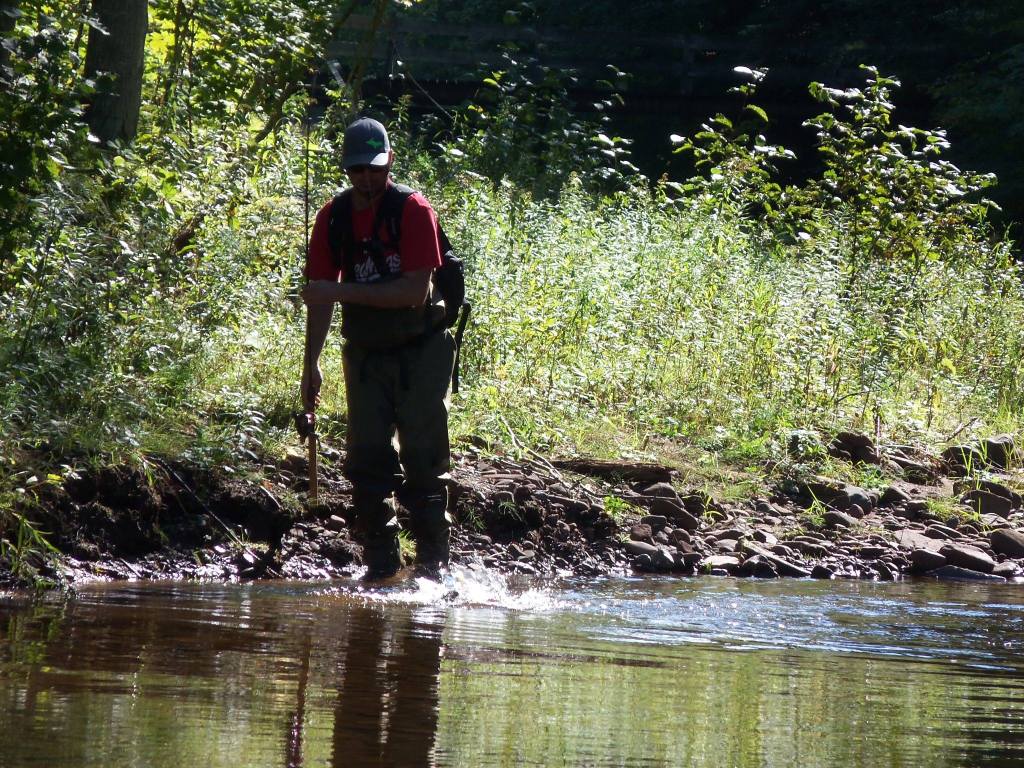
Jeremy, landing a Humpy
There was muscle memory and calculus and artistry behind each arced trajectory of the well-placed fly.
I, on the other hand, was perfectly content to bumble along comfortably behind. In my knee-high rubber boots, I wandered about in the cool water, scrambled up and down the banks, climbed a rather canyon-like sandstone cut wall and was startled by a snake upon breaking over the top, and stared at a cloud for a while unable to decide whether it looked like Elvis or Tupac.
Jeremy slowed down to work a narrow part of the river with stair-step rapids, giving me the opportunity to pass him up on the bank high above.
The Little Carp widens and its bed levels out near its mouth, giving the tannin-stained waters a brief and lazy respite before colliding headlong into the rollers and surf of Lake Superior. Some hikers with polarized sunglasses were on the banks in this area watching fish.
That water was about eight inches deep that day and there was a large log in the middle that made for a good place to sit and wait while Jeremy methodically worked his way downstream. My feet were overheated from walking that last stretch overland in black rubber boots, and the cool water felt delightful washing over them.
Occasionally there was a tap against my boots. This was confusing, as the current was quite slow and not strong enough to carry debris. The sun started creeping slowly toward the horizon and the shimmer on the water became less intense. The mystery of the boot taps was solved upon being able to see the riverbed thick with brown trout and salmon. Scores of fish. And suddenly I felt the spirit of my late friend Jamie.
The longer one looks at this image, the more fish one sees!
I did not need to sneak up on the brown trout as it was right there, and I did not lull it into a mistaken sense of security by tickling its belly.
But I did patiently slip my hand into the water, and when the moment was right, snatched the brown trout out of the water with my bare hand. I held it out before me and in a rather weird moment our eyes locked. I said out loud, “what the fuck?”, and this next part may well have been my imagination, but it looked like the brown trout was mouthing “what the fuck?” simultaneously in return.
“What the fuck?” this fish said to me
Jamie, wherever you are I am sorry for doubting you.
The entire fish out of water encounter lasted seconds at best. With a quick wiggle and a splash, the brown trout slipped out of hand and was gone.
“Jer, I caught a fish!”, I then shouted out incredulously, but he was too far upstream to hear. The half dozen folks standing about the river saw me standing in the water, sans fishing pole and with empty hand outstretched. They probably uttered under their breath, “what the fuck?”
Jeremy eventually made his way down. He listened patiently to this fantastic tale, then detailed his catching and releasing one humpback salmon and six king salmon.












 The Unexpected Minimalist